Oslo University Hospital partners in Estonian precision medicine initiative
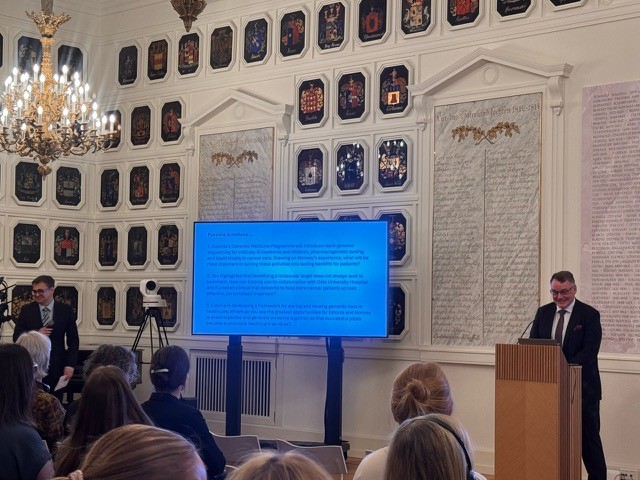
Experience from the European collaborative project PRIME-ROSE has helped launch a new genomic medicine project in Estonia, funded by EEA and Norway Grants. Oslo University Hospital (OUH) is a partner.
On Tuesday 10 November, the EEA “Public Health” programme was launched at the Estonian Statehood House in Tallinn. One of the pre-defined projects in the programme is the “Genetic Medicine Programme for Estonia 2026–2031”, led by Tartu University Hospital. The Norwegian partners are the Institute for Cancer Research and the Norwegian Newborn Screening Programme at OUH, together with the Norwegian Directorate of Health.
Professor Kjetil Taskén, Head of the Institute for Cancer Research, spoke at the launch at the invitation of the Estonian Ministry of Social Affairs. His talk covered precision cancer medicine in Europe and the path towards clinical use. Norway’s Ambassador to Estonia, Juliana Baffoe, and representatives of the Norwegian Directorate of Health were also present.
From PRIME-ROSE to EEA and Norway Grants funding
The precision medicine initiative grew out of the Horizon Europe funded PRIME-ROSE project. Work in PRIME-ROSE showed that several countries in Central and Eastern Europe lacked parts of the infrastructure they needed to take part as full partners in precision cancer medicine trials.
After Norway renewed the EEA agreement (negotiations concluded in 2024 and the agreement was signed in 2025), negotiations began on the EEA funds for the next seven-year period. These funds go to beneficiary countries in Central and Eastern Europe through the EEA and Norway Grants mechanism. Norwegian authorities backed Taskén in telling cancer communities in the beneficiary countries that Norway would be open to proposals to use EEA funds for precision medicine, if their health authorities chose to make it a priority.
Estonia ran with that idea. They are now getting a project that strengthens their own health service and also makes it easier for them to take part in European studies with us, says Taskén.
Cancer and critically ill children
The genetic medicine project has two main tracks. One is the analysis of circulating tumour DNA (ctDNA) in blood samples from cancer patients. The other is rapid sequencing in children admitted to intensive care.
Along withTaskén and the Institute for Cancer Research, Hege Russnes and colleagues from InPreD are taking part, as are Olve Moldestad and colleagues from the Division of Paediatric and Adolescent Medicine. OUH’s rare disease specialists are also involved.
The collaboration links the Estonian project to Norwegian precision medicine work and to European projects such as PRIME-ROSE.
Links:
